Showing posts with label books. Show all posts

6.12.2008

The Spirituality of Pain?

A couple of months ago I posted about the Book of Job class I attended at my temple. Since then I've begun reading (and am close to finishing) The Journey Home: Discovering the Deep Spiritual Wisdom of the Jewish Tradition by Rabbi Lawrence A. Hoffman. There are a number of passages that speak directly to the issues that the Book of Job class brought up and I'm going to chat a little bit about them now.

Rabbi Hoffman states that "in Deuteronomic theology... we always get what we deserve" and goes on to detail the 2 instances where this theology is challenged–Ecclesiastes and Job. Throughout Ecclesiastes the author "recognizes the futility of imagining that if we are only good, we will prosper," but in the end "the great skepticism...is denied in a simple one-line conclusion that reasserts Deuteronomy's promise of justice: 'The sum of the matter, when all is said and done: revere God and observe his commandments, for this applies to all man-kind, that God will call every creature to account for everything unknown be it good or bad' (12: 12-13)." [all quotes p. 165]. I don't agree with Hoffman that the last line necessarily negates the rest of Ecclesiastes (though I am speaking here based on just what he has written and not with first-hand knowledge of the book, which I've never read completely). Does the last statement really deny the idea that prosperity comes from doing good and downfall comes from doing bad? Could it be that yes, what you do or don't do may not cause your suffering or your blessing, but you WILL eventually have to answer to God, whether that be on Yom Kippur or when you die, or whenever. We don't know how God will call us to account, but we can certainly imagine, and isn't it just like children to imagine the worst from their parent? If we go with the idea of God as Father or as King (melekh), do we not fear the worst when going against what they have asked?

Hoffman turns to the Book of Job, taking time to go through the arguments set forth by Job and by his friends, pointing out that the "ostensible point of the book is Job's unswerving faith in God despite his sufferings. But though he refuses throughout to curse God, he refuses equally to blame himself his afflictions" (166). In the end Job never admits he is the cause of his own suffering, nor does he curse God, instead just admitting that God is mighty and that he (Job) does not understand His ways. In response to the ending of Job, Hoffman states that "God admits, then, how wrong it is to hold that only the guilty experience tragedy and how equally mistaken to argue that God offers suffering as a loving corrective to human beings" (167).
As we saw previously in our discussion of Gnositicism, the Rabbis thoroughgoing monotheism made them concede that somehow, even the evil in the universe must come ultimately from God. But their balanced estimate of human character prevented their painting everyone as a complete sinner, and they seem to have recognized that suffering cannot be explained solely as punishment that is never undeserved or even that it is a blessing in disguise, a mild rebuke that is ultimately for our own benefit. - p. 168
So, where does that take us? What does it mean to suffer? Can we find anything spiritually fulfilling in it? Honestly, it depends on how you look at it and how you deal with it; if you believe that you have sinned and therefore caused your own suffering, is that going to help you get better? Will you, in fact, cause your situation to worsen because of this attitude and belief? Conversely, if you say "what will happen will happen" will you treat all situations as being left up to fate, to random chance? Should there not be a middle ground, where we can grant that suffering and illness are not caused by sins we commit, but are caused by something? If you get lung cancer after you have smoked 3 packs a day for 50 years are you being punished for sins, or are the physical repercussions of your actions just finally catching up to you? It would be a comforting thought to know that if we did good we would be happy, and when it does work out that way we feel vindicated in our beliefs. But, when we base our beliefs on a system that can, in the end, disappoint us, where does that leave our beliefs?

Rabbi Hoffman states that "suffering may have meaning. People want to believe that it does. But the dominant meaning-making schemes that surround it are morally unsavory. Sickness is not sent by God; it is not God's way of punishing us; we are not responsible for it ourselves; it does not express our inner character; and pain is not good for anyone" (173). He isn't saying that we aren't responsible for ourselves at all, because we can just as easily fall into the pattern of not taking any responsibility, but if you just think about it logically, who can honestly say that pain is good? That suffering is good?

6.06.2008

תהו ובהו

In a famous passage from a fifth-century collection of rabbinic musing, we find the Rabbis wondering how God knew in advance what the universe should look like. If, as the Rabbis staunchly maintained, God created the universe out of nothing, there could have been no preexistent model available. How, then, did God, the divine architect, imagine a universe when no such architecture had ever existed before. The Rabbis solve the problem by imagining that God used the Torah as a primal blueprint. It is as if the Torah is eternal, transcending all time, even the moment of the big bang, when time as we know it began.
-- The Journey Home: Discovering the Deep Spiritual Wisdom of the Jewish Tradition, by Rabbi Lawrence A. Hoffman; p. 32
It is difficult for us, as humans with a long history to draw on, to imagine God creating something from nothing, with no reference points at all. I find it interesting that the Rabbis mentioned above felt the need to figure out how God knew what things would look like if He had no reference to begin with as it seemingly ignores the idea of the ineffable God that Heschel writes so well about. It is not surprising that the Rabbis couldn’t grasp the idea that God does not need a reference point to create, because, well, He’s GOD and we are not. It is inconceivable to the human mind to be able to imagine a world with no reference to anything else; we simply cannot grasp the idea of תהו ובהו and so how could we understand how God created the world from nothing? But, I would argue that it isn’t something we should try to understand or explain away. We cannot know the nature of God; we can search, and we can hope to find some sliver of understanding in our prayers and our deeds, but the bulk of God will always be out of reach. Personally, I’m okay with that. I don’t know that I would be able to handle the awesome ability to understand God, nor do I think I would want to.

To me the simple explanation is that God is God and if how He created the world without a reference is because He is God and it will remain a mystery to me.

However, returning to the quote above in context, the Rabbi Hoffman is trying to illustrate how “Torah defines the ideal shape of human life.” He goes on to detail how the Torah is much like Human life, with Genesis illustrating birth and childhood, Exodus is our lives as young adults, Leviticus dealing with our day to day lives where we find purpose, Numbers is our mid-life crisis, and Deuteronomy our end of life. I’m not far enough into the book to really write about what he is getting at, but it’s interesting and thought provoking so far, so I’m sure I’ll have more to say at a later date.

I’ll leave off with one last quote from Rabbi Hoffman as he addresses Leviticus:
The first two Hebrew words in the book are crucial: vayikra elohim. “God called.” The centerpiece of spiritual life is the sense that we are not here by accident. We are called. That is to say, every moment of life, from beginning to end, is a chance to rehear God’s love-laden call to purpose.
--p. 37

3.24.2008

Autonomy

I've been going through some of the books I read when first exploring Judaism and came across One People, Two Worlds: A Reform Rabbi and an Orthodox Rabbi Explore the Issues That Divide Them by Ammiel Hirsch and Yaakov Yosef Reinman. I highly recommend it for anyone who is just beginning to read about Judaism and is curious about the differences between Orthodox and Reform. And I encourage people who already know where they stand to read it as well. It is basically a book-long conversation through e-mails between a Reform rabbi and an Orthodox rabbi. As I re-read sections a number of things that I've been mulling over recently seemed to become coherent strands of thought, which is what's below.

“You misunderstand the concept of autonomy in the non-orthodox world. It is not ‘legitimized nonobservance as a final destination,’ as you describe. Rather it is an effort to encourage people to become more observant with greater and longer-lasting commitment, through their free and voluntary acceptance of the yoke of commandments. This is what freedom means in the Jewish sense. It is no the ability to do, or the desirability of doing, as we please, but the exercise of free will so we can better serve God.”

--Ammiel Hirsch, in response to Yosef Reinman, One People, Two Worlds, p. 236


That is the best argument (or at least the most coherent and straight-forward one) for Reform autonomy that I have read. I am a big believer in autonomy, in making informed choices, not only about your personal observances, but about what you believe. I think all Jews by Choice value autonomy to a certain degree, whether they are Reform, Conservative, or Orthodox. Because we all made very clear efforts to make a a break with our upbringing, to educate ourselves, and with that information make a choice about what we believe and where we would seek out God and community.

Beyond that I believe that God likes people who are able to challenge things, challenge God, stand up for what they believe—our best examples are two of our most revered figures in the Torah, Moses and Abraham. We learn early on that non only is it okay to argue with God it is practically encouraged. Why should we, as modern Jews, heirs to the same covenant that began with Abraham, behave differently?

It all comes back to how you view the transmission of the Torah and the Talmud–were they transmitted as a whole to Moses directly from God? Were they revealed progressively over many years and to future sages? Was it all man-made? Divinely inspired? Do we accept the absolute yoke of the commandments or do we accept the yoke of responsibility to try to live as good Jews with the mitzvot as a guide and our source? Do we accept the idea that fences should be built around and around these Torah laws and never taken away? Or do we acknowledge that so many of these laws were additions as reactions to the times and places in which the commentators lived?

I do not deny that the sages of the Talmud were great, beyond the scope of any ordinary scholar. However, I hold that they were still men of their times who faced challenges of faith and religion that were unique to them in some ways and universal in others, but that they were still citizens of a particular time and place. And as such were writing and responding in reference to that time and space. They did not exist in a vacuum and they were not prophets who could envision future times. They saw the world around them and they responded to it. And over the years more sages responded in light of their own time until we have this amazing conversation through the ages–a great one to be sure– but one that can, and must, continue today. I’m not saying that we add to the Talmud. I’m saying that Judaism has valued commentary that comes out of your particular moment in the past, so why should we abandon that today? Perhaps the early Reform movement responded too drastically to modernity, but they were responding and adapting just as our ancestors did in t he days after the destruction of the 2nd temple. It could be argued that the trauma of the Temple’s destruction could be paralleled with the trauma of escaping the ghetto and experiencing freedom for the first time in years. I say trauma because just as in the 1st century when our sages had to envision a Jewish world without the Temple and without sacrifice, envision ways to hold people in their faith, so too did our modern rabbis need to adapt our practices to help the non-ghettoized Jews remain connected to Judaism. And maybe some of their choices were overly dramatic, but as a movement and a people we are seeking a balance and a continued answer to modernity. We are not done with our conversation in the Reform movement. Just as the conversations of the Talmud last generations, so will ours.

Yosef Reinman states that the Reform movement that is “constantly defining and redefining itself, constantly interpreting and reinterpreting according to the dictates and demands of the people” (p. 69). I would argue that this is exactly what the rabbis of the Talmud did. They were constantly interpreting and reinterpreting Torah and midrash. Today we have thousands of years more of Jewish thought to draw on, but we are doing the same thing, and I believe it is just as legitimate. The Orthodox do not have a monopoly on holiness, on the mitzvot, on Torah, the Talmud, and other texts. I am just as free to study these and to make my decisions about what I feel commanded to observe. I have written a number of times about my views on autonomy and recently on my views of keva and kavanah. But what it comes down to is my belief that you must figure out your own observance for yourself. Be consistent with your process and serious with your efforts, but it is still a personal choice. In the end it is about God and trying to honor God and bring holiness into both your life and the entire world.

3.18.2008

My New Rashi Chumash


I recently received as a generous gift the Metsudah Chumash/Rashi pictured above. I've only had it for one parashah so far, but it was a joy to be able to study Rashi without needing to borrow my rabbi's books, and I have found it easier to use than his volumes, which have a confusing layout. My rabbi had suggested the getting into Rashi's head would be good for my studies so I'm looking forward to years of learning with this great set.

1.23.2008

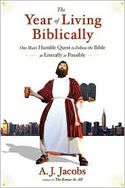
The Year of Living Biblically

Last week I read The Year of Living Biblically by A.J. Jacobs. I had heard from a number of friends that it was something I would enjoy, and being a fan of the author already, I figured it was definitely worth my time, especially considering the premise of the book. If you don't know what it is about, here is how he describes it on his website:
"The Year of Living Biblically is about my quest to live the ultimate biblical life. To follow every single rule in the Bible – as literally as possible."

With that in mind, I sat down Thursday night to read and could not put it down. Between 8pm and midnight I had read 2/3 of the book and finished it Friday evening after temple.

My initial reaction to it is that it was an admirable undertaking, especially for a self-described agnostic. I had been curious ahead of time how much he would follow strict biblical law versus later interpretation (and by later I mean Talmudic). It turns out that he truly was trying to follow what the bible says and not what the rabbis later deemed the bible meant. For instance, there is the commandment to wear fringes on the corners of your garments. He decided, at first, to take this quite literally and attached tassels to his shirt collars, which made me chuckle, trying to imagine this crazy, bearded man with tassels that you would see on a curtain (or so I pictured) hanging down from his collar.

What struck me most, however, were some of the conclusions that Jacobs came to throughout his year. Most significantly, I think, is that he came to realize that religion, at least Judaism, can't be a solitary pursuit to have the significance that one is often looking for. You need community to celebrate with, mourn with, pray with, and simply live a religious life with. A lot of people would agree that it is so much easier to live a certain way if the people around you are also living that way. Jacobs tried to do so much of his following of the commandments as an individual that I think he truly missed out on how much the religion can shape your life for the better. The results of his journey would have been completely different had he been trying to follow one religion strictly instead of the bible.

I would recommend this to anyone who is trying to observe more mitzvot, or even for people who aren't. It's an insightful and interesting read on a topic approached with humor that so many times is approached with seriousness that can border on fanaticism.